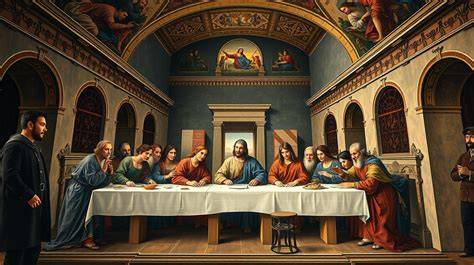
Leonardo da Vinci Utolsó vacsorája a milánói Santa Maria delle Grazie kolostor refektóriumának falára készült, 1494 és 1498 között, Ludovico Sforza megrendelésére. A mű Jézust és a tizenkét apostolt ábrázolja azon a drámai pillanaton, amikor Jézus bejelenti, hogy egyikük el fogja árulni.
A festmény különlegessége, hogy Leonardo nem hagyományos freskótechnikát használt, hanem olaj- és temperafestékkel dolgozott száraz vakolaton. Ez lehetővé tette számára a lassú, részletes munkát és az apostolok érzelmeinek pontos ábrázolását, ugyanakkor a kép már röviddel elkészülte után romlani kezdett.
Szövegértési feladat: The Last Supper
Olvasd el a szöveget!
Have you ever seen a story that lives on a wall? I live in a big, quiet room with high ceilings in a city called Milan, in Italy. I am not a painting on a canvas that you can pick up and move. I am part of the wall itself.
I can feel the cool plaster beneath my colors and hear the soft whispers of people who travel from far away just to see me. In my picture, you can see a very long table filled with friends sharing one last meal together. Behind them, light shines in from windows, making the whole room glow.
Every person at my table has a different look on their face. Some look surprised, some look a little sad, and others look very curious. I am a special moment captured in time, a very important dinner that happened a long, long time ago. I am the painting called The Last Supper.
An amazing man with a giant imagination gave me life. His name was Leonardo da Vinci, and he was much more than just a painter. He was a scientist, an inventor, and a dreamer.
Around the year 1495, he picked up his brushes and began to paint me. He put me on the dining hall wall where monks, who were special church helpers, ate their meals every day.
Leonardo wanted me to be extra special, so he didn't use the usual kind of paint that sinks into wet plaster. Instead, he tried a brand new idea, painting right onto the dry wall. This made my colors pop and look super bright.
He worked very slowly and carefully. Sometimes he would stare at me for a whole day and only add one tiny stroke of his brush. He wanted to perfectly show how each person at my table felt when their friend, Jesus, told them some surprising news.
He painted their hands and their faces to show all of their big feelings. It took him until the year 1498 to finally finish me, but he made sure every single detail was perfect.
Because Leonardo used his own special kind of paint, I have become very old and delicate over the hundreds of years I have been on this wall. Parts of me started to fade and crumble away.
But people knew my story was too important to lose. So, very kind and careful people worked for a long, long time to gently clean me and save me so I wouldn't disappear.
Today, friends and families travel from all over the world to visit me in Milan. They stand quietly and look at the faces of all the friends sitting at my table.
They see a story about love, friendship, and one very important moment. I help them see that a single moment can hold so many feelings, and that a painting can tell a powerful story without using a single word.
I hope my story reminds you that art helps connect us all, letting us wonder and feel things together, no matter how much time has passed.
1. Igaz vagy hamis?
Olvasd el az állításokat, és írd melléjük: True vagy False.
- The painting is on a movable canvas.
- The Last Supper is located in Milan.
- Leonardo da Vinci was only a painter.
- Leonardo began painting the work around 1495.
- The painting was made on a dry wall.
- Leonardo worked quickly and finished the painting in a few weeks.
- The painting shows the feelings of the people at the table.
- The painting became old and delicate.
- People tried to save the painting.
- The painting tells a story without using words.
Megoldások
- False
- True
- False
- True
- True
- False
- True
- True
- True
- True
2. Feleletválasztós feladat
Válaszd ki a helyes megoldást!
- Where is The Last Supper located?
a) Rome
b) Milan
c) Venice - What is the painting part of?
a) A wooden door
b) A canvas
c) A wall - Who painted The Last Supper?
a) Leonardo da Vinci
b) Michelangelo
c) Raphael - What else was Leonardo da Vinci?
a) A scientist and inventor
b) A king
c) A soldier - Where did the monks eat their meals?
a) In the dining hall
b) In the garden
c) In the church tower - What kind of surface did Leonardo paint?
a) Wet plaster
b) Dry wall
c) Metal - How did Leonardo work?
a) Slowly and carefully
b) Loudly and carelessly
c) Very quickly - What did Leonardo show in the faces and hands?
a) Different emotions
b) Names of the apostles
c) The weather - What happened to parts of the painting?
a) They became brighter
b) They faded and crumbled away
c) They moved to another wall - Why do people visit the painting?
a) To see its story and the faces of the people at the table
b) To hear it speak
c) To buy the original painting
Megoldások
- b)
- c)
- a)
- a)
- a)
- b)
- a)
- a)
- b)
- a)
3. Hiányzó szavak
Egészítsd ki a mondatokat a megfelelő szavakkal!
Milan, wall, Leonardo da Vinci, scientist, dry, emotions, 1498, delicate, save, story
- The painting is in __________, Italy.
- The painting is part of the __________ itself.
- __________ gave the painting life.
- Leonardo was a painter, a __________, an inventor, and a dreamer.
- He painted right onto the __________ wall.
- He showed the people’s __________ in their hands and faces.
- Leonardo finished the painting in the year __________.
- The painting became old and __________.
- People worked carefully to __________ the painting.
- The painting tells a powerful __________.
Megoldások
- Milan
- wall
- Leonardo da Vinci
- scientist
- dry
- emotions
- 1498
- delicate
- save
- story
4. Szókincsfejlesztő feladat
Párosítsd az angol szavakat a magyar jelentésükkel!
| Angol szó | Magyar jelentés |
|---|---|
| wall | érzelem |
| painting | fal |
| plaster | festmény |
| emotion | vakolat |
| friendship | barátság |
| delicate | részlet |
| detail | törékeny |
| inventor | feltaláló |
| whisper | suttogás |
| ceiling | mennyezet |
Megoldások
| Angol szó | Magyar jelentés |
|---|---|
| wall | fal |
| painting | festmény |
| plaster | vakolat |
| emotion | érzelem |
| friendship | barátság |
| delicate | törékeny |
| detail | részlet |
| inventor | feltaláló |
| whisper | suttogás |
| ceiling | mennyezet |
5. A festmény legfontosabb adatai
Az Utolsó vacsora, olaszul Il Cenacolo, a Santa Maria delle Grazie milánói kolostorának refektóriumában található. A művet Leonardo da Vinci valószínűleg 1494 és 1498 között festette.
| Szempont | Adat |
|---|---|
| Cím | The Last Supper, Il Cenacolo |
| Alkotó | Leonardo da Vinci |
| Keletkezés | c. 1495-1498 |
| Helyszín | Refectory, Santa Maria delle Grazie, Milan |
| Méretek | 460 × 880 cm |
| Megrendelő | Ludovico Sforza, Duke of Milan |
| Technika | Tempera and oil on gesso, pitch, and mastic over a dry stone wall |
| Világörökségi státusz | UNESCO World Heritage Site since 1980 |
Last Supper, one of the most famous artworks in the world, painted by Leonardo da Vinci probably between 1494 and 1498 for the Dominican monastery Santa Maria delle Grazie in Milan.
It depicts the dramatic scene described in several closely connected moments in the Gospels, including Matthew 26:21-28, in which Jesus declares that one of the Apostles will betray him and later institutes the Eucharist.
According to Leonardo’s belief that posture, gesture, and expression should manifest the “notions of the mind”, each one of the 12 disciples reacts in a manner that Leonardo considered fit for that man’s personality.
The result is a complex study of varied human emotion, rendered in a deceptively simple composition.
6. A jelenet és a szereplők
A festmény középpontjában Jézus ül, tőle jobbra és balra helyezkedik el a tizenkét apostol. Jézus piros és kék ruhát visel, szakálla van, de Leonardo nem festett köré hagyományos glóriát.
Some scholars have proposed that the light from the window behind him serves this role or that the implied lines of the pediment above the window create the illusion of a halo.
Other scholars have argued that the missing attribute may also suggest that Jesus is still a human being, who, as such, will endure the pain and suffering of the Passion.
A jelenet nem egyetlen, mozdulatlan pillanatot ábrázol. Jézus bejelentette közelgő elárulását, az apostolok pedig különböző módon reagálnak a hírre.
Philip, who stands in the group to Jesus’ left, gestures toward himself and seems to say, “Surely not I, Lord?”
Jesus seems to reply, “The one who has dipped his hand into the bowl with me will betray me” (Matthew 26:23).
Simultaneously, Jesus and Judas, who sits with the group to Jesus’ right, reach toward the same dish on the table between them, an act that marks Judas as the betrayer.
Jézus egyszerre mutat a borospohár és a kenyér felé, ami az eucharisztia, vagyis a szentáldozás megalapítására utal. Nyugodt testtartása és lehajtott feje erős ellentétben áll az apostolok izgatott mozdulataival.
Jesus also gestures toward a glass of wine and a piece of bread, suggesting the establishment of the Holy Communion rite.
Jesus’ serene composure, with his head and eyes lowered, contrasts with the agitation of the Apostles.
Their varying postures rise, fall, extend, and intertwine while remaining organized in groups of three.
James the Greater, to Christ’s left, throws his arms out angrily while the disbelieving Thomas, crouched behind James, points upward and seems to ask, “Is this God’s plan?”
His gesture anticipates his later reunion with the resurrected Christ, a moment that was often represented in art with Thomas using his fingers to touch Christ’s wounds from the crucifixion to quell his doubts.
Peter, who is identified by the knife in his hand that he will later use to sever the ear of a soldier attempting to arrest Jesus, moves toward the mild-tempered John, who sits to Jesus’ right and appears to swoon.
Judas, gripping the purse that contains his reward for identifying Jesus, recoils from Peter, seemingly alarmed at the other Apostle’s quick action.
The rest of the Apostles appear to whisper, grieve, and debate among themselves.
Feladat: ki mit fejez ki?
Párosítsd a szereplőt a hozzá kapcsolódó jellemzővel!
- Jézus
- Júdás
- Péter
- János
- Fülöp
- Tamás
- pénzes erszényt tart
- nyugodt marad
- késsel jelenik meg
- elájulni látszik
- önmagára mutat
- felfelé mutat
Megoldások
- Jézus - nyugodt marad
- Júdás - pénzes erszényt tart
- Péter - késsel jelenik meg
- János - elájulni látszik
- Fülöp - önmagára mutat
- Tamás - felfelé mutat
7. Kompozíció és perspektíva
The meal takes place within an almost austere room so that the viewer focuses on the action taking place in the foreground.
Dark tapestries line the walls on either side, while the back wall is dominated by three windows that look out on an undulating landscape recalling Milan’s countryside.
Leonardo represented the space by using linear perspective, a technique rediscovered in the Renaissance that employs parallel lines that converge at a single vanishing point to create the illusion of depth on a flat surface.
He placed the vanishing point at Jesus’s right temple, thus drawing the viewer’s attention toward the main subject.
Leonardo egy olyan szobát ábrázolt, amely vizuálisan a kolostor refektóriumának folytatásaként hat. Ez különösen illő megoldás, mivel a festmény alapvető témája - az étkezés - összekapcsolódik a refektórium rendeltetésével.
In painting the Last Supper, Leonardo created the effect that the room in which Christ and the apostles are seen was an extension of the refectory.
The room terminates at three windows on end of wall and through the windows we can see into a beautiful landscape setting.
We see how the landscape in the background terminates in a kind of misty, grayish horizon.
This painterly device, in which the horizon’s colors become more dull and colorless, is called aerial perspective and was used by Renaissance artists to create the illusion of depth in landscape scenes.
As far as the composition is concerned, Christ is in center among the apostles, and his body forms a triangle-like shape which is not overlapped by any apostles.
There are four sets of three apostles at the table beside Christ, and these numbers may have been important for Leonardo for symbolic reasons.
For example, there are four Gospels in the Bible, and three is the number of the Trinity.
We can easily see Leonardo’s use of one-point linear perspective, in which the vanishing point is at Christ’s head.
The orthogonals can be seen by following the tops of the wall tapestries or the coffers to where they intersect at Christ, which his also framed by the pediment above and back-lit by the open window behind.
Feladat: egészítsd ki a mondatokat!
- Leonardo one-point __________ perspective was used to create the illusion of depth.
- The vanishing point is located at Christ’s right __________.
- There are __________ windows behind the figures.
- The apostles are organized in groups of __________.
- The distant landscape uses __________ perspective.
Megoldások
- linear
- temple
- three
- three
- aerial
8. A festési technika és a romlás okai
Leonardo likely began working on the painting in 1495 and, as was his manner, worked slowly with long pauses between sessions, until he finished in 1498.
Because of Leonardo’s notorious perfectionism, true fresco painting was not ideal, as the process requires that an artist apply paint quickly to each day’s fresh plaster before the plaster dries and bonds the pigment to the wall.
Instead, Leonardo tried an experimental technique using tempera or oil paint on two layers of dry preparatory ground.
His compromised process meant that the pigments were not permanently attached to the wall, however, and the painting began to flake within a few years.
It continued to deteriorate, suffering from the steam and smoke of the monastery’s kitchen, soot from the refectory’s candles, and the dampness of the location.
Leonardo azért választott kísérleti módszert, mert a száraz felületen lassabban és részletesebben tudott dolgozni. A hagyományos freskótechnika gyors festést kívánt a még nedves vakolatra, ezért kevésbé felelt meg a művész aprólékos munkamódszerének.
Leonardo da Vinci’s Last Supper is a Renaissance masterpiece, though it is one which has struggled to survive intact over the centuries.
It was commissioned by Duke Ludovico Sforza for the refectory of the monastery of Santa Maria delle Grazie in Milan, and in order to paint it Leonardo used an oil/tempera mix and applied it to a dry wall.
He did this because he wanted to capture the look of an oil painting, but even within his lifetime it began to wear off.
Feladat: ok és következmény
Kapcsold össze az okokat a következményekkel!
| Ok | Következmény |
|---|---|
| A festék száraz falra került. | A festmény néhány éven belül hámlani kezdett. |
| A kolostor konyhájának gőze és füstje elérte a művet. | A festmény tovább romlott. |
| Gyertyakorom került a refektórium levegőjébe. | A felület szennyeződött. |
| A helyiség nedves volt. | A festmény állapota romlott. |
9. Történelmi károk és restaurálások
In the ensuing centuries, the painting sustained additional damage. In 1652 a door was cut into the north wall, removing Jesus’ feet and loosening the paint and plaster.
Several restorations followed, with heavy-handed retouches and the application of varnish, glue, solvents, and the like.
The painting endured additional irreverence when Napoleon’s invading troops used the refectory as a stable.
After a flood in the beginning of the 19th century, mold growth damaged the painting further still.
During World War II the painting suffered its greatest catastrophe, when an Allied bomb caused the roof and one wall of the refectory to collapse.
The painting survived, but it was exposed to the elements for several months before the space was rebuilt.
After centuries of maltreatment, the Last Supper underwent an extensive and controversial 20-year restoration that was completed in 1999.
Restorers worked in small sections to remove previous retouches, layers of grime, and coats of varnish while adding beige watercolour to the parts that could not be recovered.
When the restored painting was revealed, many critics argued that the restorers had removed so much of the painting that very little was left of Leonardo’s original work.
Others, however, commended the recovery of such details as the Apostles’ expressions and the food on the table.
Az egyik leghosszabb és legrészletesebb restaurálás 1978 és 1999 között zajlott. A restaurátorok kis felületeken dolgoztak, eltávolították a korábbi javításokat, a szennyeződéseket és a lakkrétegeket, miközben igyekeztek megőrizni mindazt, ami Leonardo eredeti munkájából fennmaradt.
The 22-year Brambilla restoration (1978-1999) consumed 38,000 hours and $8 million - revealing what Leonardo intended beneath centuries of damage.
Because Leonardo used his own special kind of paint, I have become very old and delicate over the hundreds of years I have been on this wall.
Parts of me started to fade and crumble away.
Feladat: időrendi sorrend
Rendezd időrendbe az eseményeket!
- A door was cut into the north wall.
- Leonardo finished the painting.
- The Brambilla restoration was completed.
- Napoleon’s troops used the refectory as a stable.
- An Allied bomb caused the roof and one wall to collapse.
Megoldás
- Leonardo finished the painting.
- A door was cut into the north wall.
- Napoleon’s troops used the refectory as a stable.
- An Allied bomb caused the roof and one wall to collapse.
- The Brambilla restoration was completed.
10. A művészettörténeti jelentőség
Leonardo's Last Supper shattered every convention of the cenacolo tradition.
He placed Judas among the apostles instead of isolating him across the table.
He eliminated halos entirely, using backlighting through three windows to distinguish Christ.
He organized twelve figures into four dynamic groups of three - each expressing individualized psychological responses he called moti dell'anima, “movements of the soul.”
The result was the most psychologically complex painting the world had ever seen.
Az Utolsó vacsora korábbi ábrázolásai gyakran elkülönítették Júdást a többi apostoltól, Leonardo azonban ugyanabba a csoportba helyezte, mint Jánost és Pétert. Ez fokozza a jelenet drámai feszültségét, és lehetővé teszi, hogy Júdás a többi szereplő reakcióival együtt jelenjen meg.
Judas was normally arranged across the table from the other apostles in Last Supper depictions, but here he is depicted in the same grouping as John and Peter.
All of these figures would go on to play prominent roles in the Passion of Christ.
Judas in the betrayal, Peter with his denials, and John who remains with Christ at the cross.
Although the Last Supper had been depicted in art many times before, this particular moment in the story is one which had not been depicted.
This dramatic moment opens a door for Leonardo to explore the psychological reactions of the figures involved.
We can see this in the various apostles, who are linked by their hand movements.
Emotions range from protest (Philip, #8) to sadness (John, next to Christ) to acceptance (Christ).
Leonardo’s Last Supper is a type of painting which builds on the early Renaissance painting traditions in areas such as composition and perspective.
Yet, it is innovative in terms of its study of emotional reactions and psychological states, all captured in a type of naturalism which was unknown in Italian painting in the previous century.
It is thus with Leonardo that we see the beginning of the climactic years of the Renaissance when virtuosity was at its peak, when original ways of depicting figures or scenes came full force, and when the course of European art began to change as we know it.
11. Összetett nyelvvizsga-feladat
A) Egészítsd ki a szöveget!
Leonardo da Vinci painted The Last Supper in the refectory of the monastery of __________ in Milan. He worked on the painting between approximately __________ and __________. The scene shows Jesus and the __________ apostles during their last meal together.
Leonardo did not use traditional __________, because he wanted to work slowly and carefully. Instead, he painted on a __________ wall with a mixture of oil and tempera. This technique allowed him to show the characters’ __________, but it also caused the painting to deteriorate quickly.
Megoldás
Leonardo da Vinci painted The Last Supper in the refectory of the monastery of Santa Maria delle Grazie in Milan. He worked on the painting between approximately 1494 and 1498. The scene shows Jesus and the twelve apostles during their last meal together.
Leonardo did not use traditional fresco, because he wanted to work slowly and carefully. Instead, he painted on a dry wall with a mixture of oil and tempera. This technique allowed him to show the characters’ emotions, but it also caused the painting to deteriorate quickly.
B) Rövid válaszok
- Who commissioned The Last Supper?
- Where is the painting located?
- What did Leonardo use instead of a traditional fresco?
- Why is Judas important in the composition?
- Where is the vanishing point?
- How many apostles are shown?
- What happened to the painting during World War II?
- When was the extensive restoration completed?
Megoldások
- It was commissioned by Duke Ludovico Sforza.
- It is located in the refectory of Santa Maria delle Grazie in Milan.
- He used an oil/tempera mix on a dry wall.
- Judas is placed among the apostles instead of being isolated across the table.
- The vanishing point is at Christ’s right temple.
- Twelve apostles are shown.
- An Allied bomb caused the roof and one wall of the refectory to collapse.
- The extensive restoration was completed in 1999.
12. Beszédkészség és íráskészség
Beszédkészség
Beszélj két-három percig az alábbi témáról: Describe Leonardo da Vinci’s Last Supper.
A válaszban térj ki a következő szempontokra:
- where the painting is located;
- when it was painted;
- who commissioned it;
- what scene it depicts;
- how the apostles react;
- what technique Leonardo used;
- why the painting became damaged;
- why the work is important.
Íráskészség
Írj 120-150 szavas angol nyelvű leírást az Utolsó vacsoráról! Használd fel az alábbi kifejezéseket:
- Renaissance masterpiece
- dry wall
- twelve apostles
- one of them will betray Jesus
- linear perspective
- psychological reactions
- fragile painting
- restoration
13. Haladó feladat: elemezd a mű paradoxonát!
Leonardo's Last Supper exists in a state of creative tension between ambition and fragility that mirrors its theological content - the divine expressed through the perishable.
The very qualities that made it revolutionary - psychological specificity, chromatic subtlety, atmospheric depth - depended on a technique that could not survive its substrate.
What remains is estimated at somewhere between 20% and 50% of Leonardo's original brushwork, overlaid with centuries of damage, intervention, and scholarly debate about what constitutes “the real painting.”
Yet the work's power endures precisely because its innovations were conceptual as much as material.
The grouping of apostles in psychologically interconnected triads, the synthesis of betrayal and Eucharist into a single suspended moment, the use of perspective to collapse the boundary between sacred scene and lived space - these ideas survived even when the paint did not.
Every subsequent Last Supper depiction exists in dialogue with Leonardo's vision.
Vitaindító kérdések
- Why can the painting be called both revolutionary and fragile?
- How does the technique influence the history of the work?
- Why are the apostles’ gestures important?
- How does perspective connect the painted scene with the refectory?
- Can a work remain powerful even when much of its original surface has been lost?
14. Rövid ismétlő feladat
Jelöld meg a helyes válaszokat!
- The Last Supper is a:
- sculpture
- wall painting
- landscape on canvas
- The painting is located in:
- Santa Maria delle Grazie
- the Vatican Museums
- the Louvre
- Leonardo used:
- oil and tempera on a dry wall
- only watercolour on paper
- marble and bronze
- The main subject is:
- the birth of Jesus
- the announcement of betrayal and the Eucharist
- the crucifixion
- The apostles are arranged:
- in four groups of three
- in two groups of six
- in one circular group
Megoldások
- wall painting
- Santa Maria delle Grazie
- oil and tempera on a dry wall
- the announcement of betrayal and the Eucharist
- in four groups of three
Today, friends and families travel from all over the world to visit me in Milan. They stand quietly and look at the faces of all the friends sitting at my table.
They see a story about love, friendship, and one very important moment. I help them see that a single moment can hold so many feelings, and that a painting can tell a powerful story without using a single word.
Although some of Leonardo’s celebrated artistic qualities - luminous colour, soft modeling, and studied facial expressions-have been lost, viewers can still witness his skill in depicting a sequential narrative, his considered approach to creating an illusion of space, and his interest in representing human psychology in expression, gesture, and posture.
The Last Supper’s delicate condition has not lessened the painting’s appeal; instead, it has become part of the artwork’s legacy.