Augusztus 20. Magyarország nemzeti ünnepe, Szent István napja, a magyar államalapítás napja és az új kenyér ünnepe. Ezen a napon a magyarok az államalapító Szent István királyra, a keresztény magyar állam létrejöttére és a magyar állam több mint ezeréves történetére emlékeznek.
Angolul az ünnep leggyakoribb elnevezései: St Stephen’s Day, Hungary’s State Foundation Day és Hungary’s national day. Budapesten a nap leglátványosabb eseménye a Duna fölött megrendezett hatalmas tűzijáték.
Az augusztus 20-i ünnep legfontosabb angol kifejezései
| Angol kifejezés | Magyar jelentés |
|---|---|
| St Stephen’s Day | Szent István napja |
| national day | nemzeti ünnep |
| State Foundation Day | államalapítás napja |
| Saint/St Stephen | Szent István |
| King Stephen I | I. István király |
| the first king of Hungary | Magyarország első királya |
| to found | megalapítani |
| to canonise someone | valakit szentté avatni |
| fireworks display | tűzijáték-parádé |
| over the Danube | a Duna fölött |
Gyakori kérdések és válaszok angolul
What do Hungarians celebrate on 20th August?
Hungarians celebrate St Stephen’s Day, the State Foundation Day of Hungary, and the Festival of the New Bread on 20th August. August 20 is Hungary’s national day, celebrating the founding of the Hungarian state by King Stephen I in the year 1000 AD.
What is St. Stephen’s Day?
St. Stephen’s Day is celebrated on August 20 and is an official national holiday in Hungary. It honors King Stephen I, Hungary’s first king, who founded the Hungarian state over 1,000 years ago.
Why is August 20 special in Hungary?
August 20 marks St. Stephen’s Day, the founding of the Hungarian state over 1,000 years ago. King Stephen I was crowned in the year 1000 AD, officially establishing the Kingdom of Hungary and introducing Christianity to the region.
The day carries deep historical and cultural meaning for Hungarians. It’s a moment to reflect on national identity while also coming together for music, food, and community celebrations.
What is Hungary’s national day called in English?
Hungary’s national day is commonly called St. Stephen’s Day or Hungary’s State Foundation Day. It is also described as the founding day of the Hungarian state and the Festival of the New Bread.
When is St. Stephen’s Day celebrated?
St. Stephen’s Day is celebrated on August 20 every year. 20th August is a national holiday in Hungary.
Who was Saint Stephen?
King Saint Stephen laid the foundations of the Hungarian state, brought Christianity to the region and united the pagan Magyar tribes under a strong Hungarian state and Catholicism.
St. Stephen was his Christian name after he converted from his former name Vajk which he got as a pagan baby, born to King Géza of Hungary and Sarolt the daughter of a Transylvanian Hungarian nobleman.
When Vajk alias Stephen reached adolescence, an assembly was called together by his father and they decided he would be his father’s successor as the Hungarians’ next monarch.
What was King Stephen’s original name?
His original pagan name was Vajk. St. Stephen was his Christian name after he converted from his former name Vajk.
The term “Stephen” means “crown” and “standard.”
When did Stephen become king of Hungary?
His coronation as King of Hungary was in 1000 and his reign lasted for 38 years. During his reign he largely expanded the Hungarian Kingdom and spread Christianity in the Carpathian Basin.
Stephen received a crown from Pope Sylvester II and the honor of becoming the first King of Hungary in 1000 A.D. His crown is considered a holy treasure and is still found in Hungary’s precious treasures.
How did Stephen become the ruler of Hungary?
Until then, according to the tribal customs, the right of succession went to the eldest close relative of the ruler. So not too surprisingly, following the death of Stephen’s father in 997, conflict burst out concerning the rightful succession.
Stephen and his uncle Koppány, a pagan chieftain, battled for the status and power of Grand Prince of the Hungarians. The battle was won by Stephen, but it wasn’t solely his own Magyar supporters who helped him to this victory.
Stephen had married Giselle of Bavaria, daughter of Henry II The Wrangler just a few years before his father’s death and the German in-laws helped the future king to his pedestal.
What did King Stephen do for Hungary?
Stephen was of the view that the conversion of Magyar to Christianity can serve as a great way of settling down and strengthening the state.
In one of his first decrees, for example, he ordered that every ten village had to build a church and he invited foreign priests to Hungary. He also established counties in his kingdom to organize the administration of the country.
King Stephen I founded the Hungarian state in 1000 and introduced Christianity to the region. His legacy is celebrated every year on this date as Hungary’s most important national holiday.
When was Saint Stephen canonised?
He was canonized on the 20th of August 1083, becoming one of the most favoured saints in Hungary. On August 20, 1083 A.D., he was made a Catholic saint.
King Ladislaus declared August 20 a holy day and it was first celebrated in 1092 A.D. 20th of August was first celebrated in 1092 when King Ladislaus declared it a sacred day and proposed the canonisation of Stephen.
How did August 20 become a national holiday?
It was celebrated as St. Stephen’s Feast Day until 1771 when Queen Maria Theresia expanded it from a church feast to an official national holiday.
While the winds of history oppressed the open celebration of the day during the Ottoman occupation, it was reintroduced by Maria Theresa in the 18th century and was restored to its current status after the collapse of the Eastern Bloc.
It further went through amendments and in 1950 the holiday’s name was changed to Constitution Day. The Hungarian parliament reinstated it as the commemoration of St. Stephen’s Feast Day to celebrate the foundation of the Hungarian state.
Mit ünnepelnek augusztus 20-án?
A magyar államalapítást
St. Stephen’s Day holds a long and interesting history. It begins with Stephen the Grand Prince of the Hungarians who laid the foundations of the state.
Until the end of the 10th century, the Hungarians were in conflict with other European countries. In 955 A.D., Hungarian tribes suffered a major military loss and the tribal heads decided to give up their raids and concentrate on building a strong state.
St. Stephen’s Day celebrations are pivotal since this is the day when the foundations of the state of Hungary were laid.
Szent István király emlékét
It is St Stephen’s Day, the State Foundation Day of Hungary, and also the Festival of the New Bread. Ez Szent István napja, a magyar államalapítás napja, és az új kenyér ünnepe.
The State of Hungary was founded in 1000 by King Stephen I. A magyar államot I. István király alapította, 1000-ben.
He was canonised on 20th August. Augusztus 20-án avatták szentté.
Az új kenyeret
The 20th of August also marks the Hungarian Festival of the New Bread: the blessing and slicing of a freshly baked loaf of bread is a widespread ceremony in the country that day and even across the border, in Transylvania.
At the end of the summer, after the grain harvest, the first bread from the new wheat was baked on this day. The round bread is adorned with a ribbon in the national colors and the blessing is also part of the ceremony.
Hogyan ünneplik augusztus 20-át Magyarországon?
Hivatalos ünnepségek
The official celebration begins with the ceremonial hoisting of the national flag on Kossuth square, where the Parliament building is located, followed by the carving of the Cake of Hungary and giving many of the state awards to our most distinguished citizens.
A Hungarian flag is raised at Kossuth Square in front of parliament. It is followed by a food festival where the Cake of Hungary is presented.
The state programs usually take place in front of the Parliament at Kossuth Square and at Heroes Square. The Hungarian flag is hoisted, generally marching bands play, there are archery shows, dances, traditional Hungarian crafts workshops, ox and poultry roasted on open fires.
A Szent Jobb körmenete
There is also an organised procession held in honour of the Holy Right hand, the mummified right hand of St. Stephen.
The Holy Right Hand procession is a religious procession that carries the relic of St. Stephen’s right hand from St. Stephen’s Basilica through the city center.
Then a mass in St. Stephen’s Basilica and a march in the honor of Holy Right-Hand takes place. St. Stephen’s day can be celebrated by attending any of these events.
Mi a Szent Jobb?
In the canonization process, it was found that King Stephen’s right hand had not decayed at all, hence it was removed and can now be seen in St. Stephen’s Basilica in Budapest.
His remaining right hand, preserved whole indicating his saintly nature is called the Holy Right Hand or simply the Saint’ Right Hand. Today it can be viewed at St.Stephen’s Basilica as a relic.
A tűzijáték
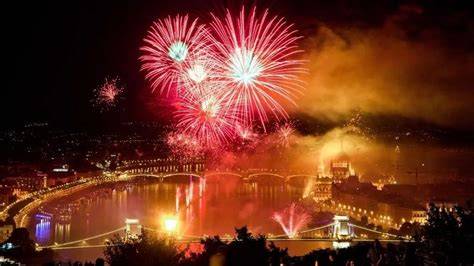
St. Stephen’s Day is celebrated with a huge fireworks display over the Danube. Szent István napja hatalmas tűzijáték parádéval ünnepelt a Duna fölött.
The fireworks mark the culmination of Hungary’s national day celebrations. They’re launched from barges on the Danube and choreographed to music, lighting up the river and iconic landmarks like the Chain Bridge and the Hungarian Parliament Building.
The biggest in the country is the one in Budapest, shot from the Danube. There are celebrations in almost every part of the country, capped off by fireworks in the evening.
Mikor kezdődik a budapesti tűzijáték?
The Budapest fireworks on August 20 usually start at 9 PM and last around 30 minutes. The exact timing can vary slightly year to year, so it’s always worth checking the official program closer to the date.
Plan to arrive at your chosen viewing spot well before 8 PM. The riverbanks and bridges fill up fast, and good spots go early.
Viewing spots along the Danube fill up well before the show begins, so plan to arrive at least an hour early if you want a riverfront position.
Honnan lehet megnézni a tűzijátékot?
The Danube riverbanks, Margaret Bridge, and Buda Castle Hill are the most popular viewing spots.
What makes Budapest’s fireworks so special is the setting. The show is launched from barges positioned along the Danube, which means the reflections ripple across the river while the lights illuminate some of the city’s most iconic landmarks: the Chain Bridge, the Hungarian Parliament Building, and Buda Castle.
Those watching from an elevated terrace or rooftop can be a bit more relaxed about timing.
Az augusztus 20-i ünnep ételei és hagyományai
A Magyarország Tortája
Each year the Cake of Hungary competition is organized by Hungarian Confectionery Industry Association on August 20th. It is a popular tradition to celebrate the most talented Hungarian confectioners and promote culinary innovation.
This cake is selected from the annual contest, arranged by the National Association of Hungarian Confectioners, that famous bakers participate in and the one with the most innovative ideas wins.
Both sugar- and sugar-free cakes are prepared.
Az új kenyér ünnepe
This day is also called ‘the festival of the new bread’ so you can also have a bite from freshly baked bread as well.
Making a birthday cake for a country is not a piece of cake. You can also enjoy the Birthday Cake of Hungary by simply looking for a bakery offering the recipe so you don’t miss out on your chance of having a slice.
Ételek és kézműves vásárok
The area around Buda Castle and Vörösmarty Square fills up with artisan markets, where local makers sell handmade goods, embroidery, ceramics, and traditional Hungarian crafts.
Food stalls serve up goulash, chimney cake, kürtőskalács, lángos, and grilled meats alongside local wines and fruit pálinka.
The Hungarian flag is hoisted, generally marching bands play, there are archery shows, dances, traditional Hungarian crafts workshops, ox and poultry roasted on open fires.
Augusztus 20-i programok Budapesten
Koncertek és kulturális programok
Live music stages pop up across the city throughout the day. Folk dance performances, classical concerts, and pop acts keep things lively from morning to night.
Other festivals take place along and above the Danube. One of the most spectacular ones is the water and air parade.
While the fireworks light the summer night skies, various dances tell the story of how Hungary was founded.
A TELJES augusztus 20-i tűzijáték
Légi bemutató a Duna fölött
One of the highlights of the day is a military air show that flies over the Danube river. Expect aerobatic maneuvers, formation flying, and impressive passes over the Budapest skyline.
Székesfehérvár királyi napjai
About 70 km far from Budapest, in Székesfehérvár history comes to life. Originally Saint Ladislaus, Ladislaus the first, canonised I Stephen in this town, what is called the Town of Kings.
It was here that the Hungarian coronation insignia, the treasury, and the archives were kept, and it was here that the king held his national law-giving days, and only the king crowned in Fehérvár could be the legitimate ruler of the country.
The Royal Days of Székesfehérvár, a multi-day arts festival organised around St Stephen’s feast, is the city’s most important event. Folk Dance Festival is also held on these days, which has been held for more than two decades.
A debreceni Virágkarnevál
In Debrecen, the Flower Carnival has been held at the end of August since 1966. The main procession is on the 20th of August, when huge floral compositions are represented, made with hundreds of thousands of flowers.
The procession is accompanied by Hungarian and foreign dancers and traditional groups parade through the streets of Debrecen.
Not far from the city, on the nine-hole bridge at Hortobágy, a World Heritage Site, the Bridge Fair is organised at this time of year, where all the traditional crafts are represented.
Hasznos angol válaszok turistáknak
What happens in Budapest on Hungary’s national day?
Budapest pulls out all the stops for St. Stephen’s Day. The city turns into one big open-air festival with events spread across multiple neighborhoods and venues.
The day includes craft and food fairs, an air show over the Danube, a religious procession from St. Stephen’s Basilica, live concerts, and the famous fireworks finale.
What is St. Stephen’s Day in Budapest?
St. Stephen’s Day, Államalapítás ünnepe, is Hungary’s national day, celebrated on August 20 each year. It honors King Stephen I, Hungary’s first king, who founded the Hungarian state over 1,000 years ago.
The day includes craft and food fairs, an air show over the Danube, a religious procession from St. Stephen’s Basilica, live concerts, and the famous fireworks finale.
Why are there fireworks in Budapest on August 20?
The fireworks are directly tied to the celebration of Hungary’s national day. They mark the end of St. Stephen’s Day and serve as a collective, city-wide tribute to the founding of the Hungarian state.
Fireworks on 20 August have been part of the celebrations since 1927.
Is August 20 a public holiday in Hungary?
As the twentieth of August is a public holiday, often falling on a weekday, Hungarians organise one last big trip or a short or long holiday at the end of the summer to celebrate the country’s biggest holiday and have one last rest before the start of autumn.
Is August 20 a good time to visit Budapest?
For first-time visitors, August 20 weekend is genuinely one of the best times to visit Budapest. The city is buzzing with energy, the weather is warm and sunny, average highs around 28°C / 82°F, and you get to experience a deeply local celebration alongside Hungarian families and travelers from across Europe.
Budapest is at its busiest in August, especially around the national day. Hotels fill up weeks in advance, and prices are higher than in shoulder season.
What other events take place in Budapest in August?
August is one of the most exciting months for Budapest events. St. Stephen’s Day is the centerpiece, but there’s plenty happening around it.
One of Europe’s biggest music festivals takes place on an island in the Danube in mid-August. It runs for a full week and attracts hundreds of thousands of visitors from across Europe, with a lineup spanning pop, rock, electronic, and world music.
Parks and courtyards across Budapest host outdoor screenings and open-air theater performances throughout August. August is the peak season for Budapest’s legendary outdoor nightlife.
Érdekességek Szent István napjáról
Mi történt Szent István koronájával?
The Crown of St Stephen was recovered after missing for decades by US soldiers at the end of World War II. It was hidden in an oil drum.
It was kept safe at a Ft. Knox vault for 32 years before being returned to Hungary in 1978 by President Jimmy Carter. Today it can be seen in the Hungarian parliament in Budapest.
Mióta rendeznek tűzijátékot augusztus 20-án?
Fireworks on 20 August have been part of the celebrations since 1927.
The launching of fireworks on this day has taken place since 1966.
Hogyan lehet röviden válaszolni arra, mit ünnepelnek a magyarok augusztus 20-án?
Hungarians celebrate St Stephen’s Day, the foundation of the Hungarian state, and the Festival of the New Bread on August 20.
August 20 is Hungary’s national holiday. It is St Stephen’s Day, the State Foundation Day of Hungary, and the Festival of the New Bread.