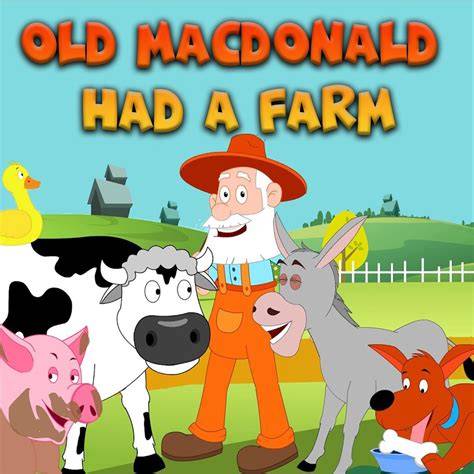
Az „Old MacDonald Had a Farm” egy közismert angol gyermekdal, amelyben a gazda farmján élő állatok és jellegzetes hangjaik jelennek meg. A dal ismétlődő szerkezete miatt a gyerekek könnyen bekapcsolódhatnak az éneklésbe, utánozhatják az állathangokat, és megtanulhatják a farm állatainak angol nevét.
Az alábbiakban az „Old MacDonald Had a Farm” több gyakori angol szövegváltozata, a dal története, az állathangok jelentése és a gyermekekkel végezhető kapcsolódó tevékenységek olvashatók.
Old MacDonald Had a Farm - teljes angol dalszöveg
Old MacDonald had a farm, E-I-E-I-O.
And on his farm he had a cow, E-I-E-I-O.
With a moo-moo here,
And a moo-moo there,
Here a moo, there a moo,
Everywhere a moo-moo,
Old MacDonald had a farm, E-I-E-I-O.
Old MacDonald had a farm, E-I-E-I-O.
And on his farm he had a horse, E-I-E-I-O.
With a neigh-neigh here,
And a neigh-neigh there,
Here a neigh, there a neigh,
Everywhere a neigh-neigh,
Old MacDonald had a farm, E-I-E-I-O.
Old MacDonald had a farm, E-I-E-I-O.
And on his farm he had a duck, E-I-E-I-O.
With a quack-quack here,
And a quack-quack there,
Here a quack, there a quack,
Everywhere a quack-quack,
Old MacDonald had a farm, E-I-E-I-O.
Old MacDonald had a farm, E-I-E-I-O.
And on his farm he had a pig, E-I-E-I-O.
With an oink-oink here,
And an oink-oink there,
Here an oink, there an oink,
Everywhere an oink-oink,
Old MacDonald had a farm, E-I-E-I-O.
Old MacDonald had a farm, E-I-E-I-O.
And on his farm he had a dog, E-I-E-I-O.
With a ruff-ruff here,
And a ruff-ruff there,
Here a ruff, there a ruff,
Everywhere a ruff-ruff,
Old MacDonald had a farm, E-I-E-I-O.
Az „Old MacDonald Had a Farm” dalszövegének másik gyakori változata
Old Macdonald had a farm, E-I-E-I-O.
And on his farm he had some cows, E-I-E-I-O.
With a “moo-moo” here and a “moo-moo” there,
Here a “moo” there a “moo”,
Everywhere a “moo-moo”,
Old Macdonald had a farm, E-I-E-I-O.
Old Macdonald had a farm, E-I-E-I-O.
And on his farm he had some ducks, E-I-E-I-O.
With a “quack, quack” here and a “quack, quack” there,
Here a “quack” there a “quack”,
Everywhere a “quack, quack”,
Old Macdonald had a farm, E-I-E-I-O.
Old Macdonald had a farm, E-I-E-I-O.
And on his farm he had some pigs, E-I-E-I-O.
With a (snort) here and a (snort) there,
Here a (snort) there a (snort),
Everywhere a (snort-snort),
Old Macdonald had a farm, E-I-E-I-O.
Old Macdonald had a farm, E-I-E-I-O.
And on his farm he had a dog, E-I-E-I-O.
With a “woof, woof” here and a “woof, woof” there,
Here a “woof” there a “woof”,
Everywhere a “woof, woof”,
Old Macdonald had a farm, E-I-E-I-O.
Old Macdonald had a farm, E-I-E-I-O.
And on his farm he had some sheep, E-I-E-I-O.
With a “baa, baa” here and a “baa, baa” there,
Here a “baa” there a “baa”,
Everywhere a “baa, baa”,
Old Macdonald had a farm, E-I-E-I-O.
Hosszabb, felhalmozódó változat
Old MacDonald had a farm. E-I-E-I-O.
And on that farm he had a pig. E-I-E-I-O.
With an oink oink here.
And an oink oink there.
Here an oink.
There an oink.
Everywhere an oink oink.
Old MacDonald had a farm. E-I-E-I-O.
Old MacDonald had a farm. E-I-E-I-O.
And on that farm he had a duck. E-I-E-I-O.
With a quack quack here.
And a quack quack there.
And an oink oink here.
And an oink oink there.
Old MacDonald had a farm. E-I-E-I-O.
Old MacDonald had a farm. E-I-E-I-O.
And on that farm he had a horse. E-I-E-I-O.
With a neigh neigh here.
And a neigh neigh there.
And a quack quack here.
And a quack quack there.
And an oink oink here.
And an oink oink there.
Old MacDonald had a farm. E-I-E-I-O.
Old MacDonald had a farm. E-I-E-I-O.
And on that farm he had a sheep. E-I-E-I-O.
With a baaa baaa here.
And a baaa baaa there.
And a neigh neigh here.
And a neigh neigh there.
And a quack quack here.
And a quack quack there.
And an oink oink here.
And an oink oink there.
Old MacDonald had a farm. E-I-E-I-O.
Old MacDonald had a farm. E-I-E-I-O.
And on that farm he had a cow. E-I-E-I-O.
With a moo moo here.
And a moo moo there.
And a baaa baaa here.
And a baaa baaa there.
And a neigh neigh here.
And a neigh neigh there.
And a quack quack here.
And a quack quack there.
And an oink oink here.
And an oink oink there.
Old MacDonald had a farm. E-I-E-I-O.
Old MacDonald had a farm. E-I-E-I-O.
And on that farm he had a turkey. E-I-E-I-O.
With a gobble-gobble here,
And a gobble-gobble there,
And a moo moo here.
And a moo moo there.
And a baaa baaa here.
And a baaa baaa there.
And a neigh neigh here.
And a neigh neigh there.
And a quack quack here.
And a quack quack there.
And an oink oink here.
And an oink oink there.
Old MacDonald had a farm. E-I-E-I-O.
E-I-E-I-O.
Állathangos kérdés-felelet változat
Old McDonald had a farm.
E-I-E-I-O.
And on that farm he had a cow.
E-I-E-I-O.
What does a cow say?
Meow? Oink? Moo?
With a moo moo here.
And a moo moo there.
Here a moo.
There a moo.
Everywhere a moo moo.
Old McDonald had a farm.
E-I-E-I-O.
Old McDonald had a farm.
E-I-E-I-O.
And on that farm he had a horse.
E-I-E-I-O.
What does a horse say?
Woof woof? Moo? Neigh?
With a neigh neigh here.
And a neigh neigh there.
Here a neigh.
There a neigh.
Everywhere a neigh neigh.
Old McDonald had a farm.
E-I-E-I-O.
Old McDonald had a farm.
E-I-E-I-O.
And on that farm he had a pig.
E-I-E-I-O.
What does a pig say?
Quack? Tweet, tweet? Oink?
With an oink oink here.
And an oink oink there.
Here an oink.
There an oink.
Everywhere an oink oink.
Old McDonald had a farm.
E-I-E-I-O.
Old McDonald had a farm.
E-I-E-I-O.
And on that farm he had a sheep.
E-I-E-I-O.
What does a sheep say?
Cluck cluck? Oink? Baaa?
With a baaa baaa here.
And a baaa baaa there.
Here a baaa.
There a baaa.
Everywhere a baaa baaa.
Old McDonald had a farm.
E-I-E-I-O.
Old McDonald had a farm.
E-I-E-I-O.
And on that farm he had a duck.
E-I-E-I-O.
What does a duck say?
Meow? Moo? Quack quack?
With a quack quack here.
And a quack quack there.
Here a quack.
There a quack.
Everywhere a quack quack.
Old McDonald had a farm.
E-I-E-I-O.
Old McDonald had a farm.
E-I-E-I-O.
And on that farm he had a rooster.
E-I-E-I-O.
What does a rooster say?
Ribbit? Meow? Cock-a-doodle-doo?
With a cock-a-doodle-doo.
Cock-a-doodle-doo.
Cock-a-doodle-doodle-doodle-doodle-doodle-doo.
Old McDonald had a farm.
E-I-E-I-O.
E-I-E-I-O.
Az állatok és angol hangjaik
| Állat angolul | Állat magyarul | Angol állathang |
|---|---|---|
| cow | tehén | moo-moo |
| horse | ló | neigh-neigh |
| duck | kacsa | quack-quack |
| pig | malac | oink-oink |
| dog | kutya | woof-woof, ruff-ruff |
| sheep | juh | baa-baa |
| chicken | csirke | cluck-cluck |
| turkey | pulyka | gobble-gobble |
| rooster | kakas | cock-a-doodle-doo |
Az „Old MacDonald Had a Farm” egyik legfontosabb eleme, hogy minden versszakban egy új állat neve és hangja jelenik meg. Az állathangok utánzó szavak, ezért a gyerekek könnyen megjegyzik őket, és játékosan gyakorolhatják az angol kiejtést.
A dal története
„Old MacDonald” did not have a farm until 1925, when the Sam Patterson Trio released a recording using this name. Before that, the song had several other names and tunes.
The first version of the song was titled “In the Fields in Frost and Snow” and was used in a 1706 English opera by Thomas d’Urfey. It is unknown whether d’Urfey wrote this version or it was already a traditional song.
While his opera was a flop, the song was loved and grew in popularity. In the 1880s, a version titled “The Farmyard Song” made the rounds.
Next, “Father’s Wood I O” was written in 1906, followed by “The Farmyard” in 1908. There was even a 1917 World War I-era version called “Ohio.”
Finally, in this version the farmer had a name: Old MacDougal. The song “Old MacDonald Had a Farm” has been translated and loved in many other languages.
For example, in Germany “Uncle Fritz Had a Farm,” and in China “Mr. Wang Has a Patch of Land.”
Miért kedvelt gyermekdal?
Today, “Old MacDonald” is often one of the first songs a child learns to sing. It is a fun way for toddlers to learn the names of the animals on the farm and the sounds they make.
Az ismétlődő dallam és az állathangok lehetővé teszik, hogy a gyerekek már akkor is bekapcsolódjanak, amikor még nem tudják végig elénekelni az angol szöveget. Először egy-egy hangot vagy szót ismételhetnek, később pedig egész versszakokat énekelhetnek.
Singing songs and rhymes will support your child's language development. Babies like learning about different animals and the sounds they make.
This is a fun way for your baby to play with sounds and work on their language skills. Babies like hearing their favourite songs again and again, so you can sing it several times. They will respond to it more once it becomes familiar.
Játékos feladatok a dallal
- Change the animals in the song.
- Try including your child's favourites or introducing some new animals.
- You could use toys, or a picture book of animals to support your baby's understanding, point to the animals as you sing.
- Notice which sounds your baby likes.
- Encourage them to join in with the animal sounds, and the words when they are ready.
- Babies like hearing their favourite songs again and again, so you can sing it several times.
A gyerekek az éneklés közben eljátszhatják, hogyan mozog a tehén, a ló, a kacsa, a malac vagy a juh. A különböző állatok mozgásának utánzása összekapcsolja a hallott szavakat a mozdulatokkal.
Music
- Listen to the song.
- Ask children to identify the animals in the song.
- Play the song again and invite children to join in with the singing and to clap the rhythm pattern “e, i, e, i, o”.
- Add different instruments or found sounds e.g. plastic bottles and fillers - rice, small stones etc. to represent the different animal sounds for each verse.
- Challenge - sing and play along to the instrumental version.
Science
- What is the function of different animals on the farm?
Visual Art
- Draw and cut out a favourite farm animal to create a class mural.
Dance
- Explore through dance how different animals move.
Literacy
- Sing and read along to the YouTube song to achieve multi-sensory learning “Do it, see it and hear it!”
- Read the song lyrics - ask children a variety of questions.
- Re-read the song lyrics and ask children to join in.
- Recognise and use a variety of punctuation when reading.
- “ ” ! ? . ,
- Look at print and conventions (bold, italics).
- Talk about interesting/challenging words and discuss what they mean.
- Word study - phonic knowledge, compound words, rhyming word, contractions etc.
A dal felhasználása angoltanulásban
Az „Old MacDonald Had a Farm” segítségével a gyerekek megtanulhatják a farmhoz kapcsolódó alapvető angol szókincset. A farm, cow, horse, duck, pig, dog, sheep, chicken, turkey és rooster szavak ismételt hallása és kimondása támogatja a szókincs bővítését.
A dal ritmusa a hallás utáni megértést és a kiejtés gyakorlását is segíti. A „What does a cow say?” típusú kérdések egyszerű párbeszédet alakíthatnak ki, amelyben a gyerekek kérdésre válaszolnak egy állathanggal.
A mozgás, a képek, a játékállatok és a hangszerek együttes használata több érzékszervet is bevon. A gyerekek így egyszerre hallják az angol szót, látják az állatot, kimondják a hangját, és mozdulattal is megjelenítik a jelentését.
Magyar jelentés és kiejtési kapaszkodó
A dal szövegének (nyers) fordítása: Az öreg MacDonaldnak volt egy farmja, juhéé! És a farmján volt neki egy tehene, juhéé! Bú-bú szólt itt, bú-bú szólt ott, Itt egy bú, ott egy bú, mindenhol bú-bú. Az öreg MacDonaldnak volt egy farmja, juhéé!
Az „E-I-E-I-O” refrént általában nem fordítják le, hanem az eredeti hangalakhoz hasonlóan éneklik. A magyar „juhéé” csak a nyers fordításban jelenik meg, az angol dalszövegben a visszatérő refrén „E-I-E-I-O”.
Éneklés és videó használata
Sing along with the barnyard animals in this fun illustrated video!
View the video song of “Old MacDonald.” Ask children what they think of the video song?
Az illusztrált videó segíthet abban, hogy a gyerekek a hallott angol szavakat képekkel kapcsolják össze. A közös éneklés közben a gyerekek tapsolhatják az „E-I-E-I-O” ritmusát, utánozhatják az állatok hangját, és a versszakok között megnevezhetik a következő állatot.
A dal további szövegváltozatai
Old MacDonald had a farm E-I-E-I-O.
And on that farm he had a cow E-I-E-I-O.
With a moo-moo here and a moo-moo there, here a moo, there a moo, everywhere a moo-moo.
Old MacDonald had a farm E-I-E-I-O.
Old MacDonald had a farm E-I-E-I-O.
And on that farm he had a duck E-I-E-I-O.
With a quack-quack here and a quack-quack there, here a quack, there a quack, everywhere a quack-quack.
Old MacDonald had a farm E-I-E-I-O.
Old MacDonald had a farm E-I-E-I-O.
And on that farm he had a horse E-I-E-I-O.
With a neigh-neigh here and a neigh-neigh there, here a neigh, there a neigh, everywhere a neigh-neigh.
Old MacDonald had a farm E-I-E-I-O.
Old MacDonald had a farm E-I-E-I-O.
And on that farm he had a pig E-I-E-I-O.
With an oink-oink here and an oink-oink there, here an oink, there an oink, everywhere an oink-oink.
Old MacDonald had a farm E-I-E-I-O.
Az „Old MacDonald Had a Farm” különböző változataiban eltérhet az állatok sorrendje, az egyes állatok száma, illetve az utánzott hang alakja. Egyes változatokban a kutya „woof-woof”, másokban „ruff-ruff” hangot ad, a sertés hangja pedig „oink-oink” vagy „snort-snort” formában jelenik meg.