Vészhelyzetben az angol nyelvű segítségkéréshez elsősorban a helyszín, a veszély típusa, a sérülések és az azonnali szükségletek rövid, egyértelmű megfogalmazására van szükség. A legfontosabb mondatok közé tartozik a „Where is your emergency?”, vagyis „Hol történt a vészhelyzet?”, valamint a „What’s happened?”, vagyis „Mi történt?”.
Ha azonnali segítségre van szükség, a segélyhívó szám országonként eltérhet. Az Európai Unióban a 1-1-2, Észak-Amerikában a 9-1-1, egyes ázsiai országokban pedig a 9-9-9 használatos. A hívás során fontos megnevezni az országot és a beszélt nyelvet is, mert ez időt takaríthat meg.
Alapvető angol szavak és kifejezések vészhelyzetben
| Angol kifejezés | Magyar jelentés |
|---|---|
| emergency | vészhelyzet |
| Where is your emergency? | Hol történt a vészhelyzet? |
| What’s happened? | Mi történt? |
| I can’t breathe. | Nem kapok levegőt. |
| Stay calm. | Maradjon nyugodt. |
| We are on our way to help you. | Úton vagyunk, hogy segítsünk. |
| We are sending the Fire Department. | Küldjük a tűzoltókat. |
| Is there a pharmacy nearby? | Van a közelben gyógyszertár? |
| Your insurance card, please. | Kérem a biztosítási kártyáját. |
Segélyhívás angolul
In most countries, people can make a telephone call to ask for medical or police help using just three numbers. In the European Union, the number is 1-1-2. Some Asian countries use 9-9-9. In North America, the number is 9-1-1.
Wherever you are in the world, when you call for help, you do not want the person answering to say “I don’t understand you.” Several managers of emergency call centers say it is important to be able to say the name of your country and your language in the language of the country you are visiting or living in. That may save you important time.
Az alábbi mondatok segítségével a hívó megadhatja a vészhelyzet legfontosabb adatait:
- Where is your emergency? - Hol történt a vészhelyzet?
- What’s happened? - Mi történt?
- What is your phone number? - Mi a telefonszáma?
- Are there other people in the house? - Vannak mások is a házban?
- Stay calm. - Maradjon nyugodt.
- We are on our way to help you. - Úton vagyunk, hogy segítsünk.
Nyelvi segítség a segélyhívó központokban
In the United States, most of the workers who answer calls for emergency help speak just one language -- English. But many people in the United States, and people coming here from other countries, do not speak English.
So VOA went to a center where requests for help are received to find out what happens when the person calling speaks a language that emergency workers do not understand. The phone call was answered by a worker in the Willamette Valley 9-1-1 Center in Salem, Oregon, in the northwestern United States.
But it could have been almost anywhere in America -- in most urban areas, workers receive requests for emergency help every day in a language other than English.
Dispatcher: “9-1-1”
Caller: [Cannot be understood]
Dispatcher: “Do you have an emergency?”
Caller: [“Español?”]
Dispatcher: “Do you have an emergency?”
Caller: “Si!”
Dispatcher: “OK. Just a moment. ”
Now, the worker will call someone at an agency that employs people who speak the caller’s language. Every 9-1-1 center in the northwestern United States works with such agencies, called emergency translation services.
TeleLanguage: “Thanks for calling. What language?”
Willamette Valley 9-1-1 Center: “Spanish.”
TeleLanguage: “One moment please.”
Computer voice: “Thank you. Your call may be monitored or recorded for quality. ”
On this call, it takes almost one minute for a translator to be connected to the person calling for help. Andrea Tobin is a training manager at the emergency center and a longtime worker there. She says the wait can be difficult for both the emergency workers and the person who needs help.
“We get pretty tense, especially if we know it is a medical call -- or this person that is in obvious distress.”
“When it is Spanish, it is pretty quick and easy for us to understand. When it is a different dialect, it becomes more complicated for us because we don’t recognize them all. And then they put us on hold while they get an interpreter for the language that we need. That can sometimes be very quick. Sometimes it is 30 seconds or a minute.”
The most-common language needing translation is Spanish. Others include Russian, Vietnamese, and Chinese. Some managers of emergency call centers in urban areas of the northwestern United States say they are experiencing an increase in requests for help from people speaking languages heard in African and Middle Eastern countries.
Translation companies like Telelanguage and LanguageLine say they can help people in 200 languages. Mark Buchholz is the director of the Willamette Valley 9-1-1 center. He says using these services is less-costly than employing workers who speak more than one language.
Only three of his 55 workers speak more than one language. Two of them speak English and Spanish. A third speaks English and Russian. Mr. Buchholz says centers like his try to employ people who speak more than one language, but he says it is not easy to find these workers.
“It’s really tough to require a second language as a requirement to work for us. While it is important -- we do pay a bonus -- the volume isn’t significant enough for us to have that as an exclusive requirement for hiring.”
Rendőrségi segítség kérése
A man has called the Salem, Oregon 9-1-1 center for help. He is speaking in Spanish. He says two men in a car are chasing him.
The interpreter is listening to the man, then talking to the emergency worker, who will send police to help the man once they know where he is.
Caller: [Words in Spanish]
Interpreter: “Lee Street, One Way?”
Caller: “Ya.”
Interpreter: “I am standing right at the corner of One Way and Lee Street.”
Dispatcher: “We don’t have a One Way.”
It took the three people another minute to find out that the man was on the corner of Lee and 12th Street. Lee Street is a one-way street -- cars are only permitted to drive on the street in one direction. The caller thought that was the name of the street.
Interpreters who join calls like this may be in another state. The companies that employ them tell the workers they can do the work from their home. These companies also help business call centers, banks, schools and courts.
In the emergency we just heard, the police were able to quickly help the man who called.
Tűzeset bejelentése angolul
Az alábbi párbeszéd egy olyan segélyhívást mutat be, amelyben a hívó szerint ég a ház, füst van az épületben, és nem kap levegőt.
Operator: 911 Where is your emergency? How may I help you?
Caller: I think the house is on fire.
Operator: Where is the emergency?
Caller: 49 Sycamore Street.
Operator: What is your phone number?
Caller: 0765 9834963.
Operator: What’s happened?
Caller: I don’t know. My roommate is downstairs, but I’m upstairs and can’t come down.
Operator: We are sending the Fire Department. Are there other people in the house?
Caller: No. I can’t breathe. I can see flames and there is smoke everywhere.
Operator: Tell my in which bedroom are you in.
Caller: I’m in the front bedroom.
Operator: Can you get on the floor?
Caller: I’m on the floor.
Operator: Is there anything you can put in front of your doorjamb to stop the smoke from coming in? A blanket or something?
Caller: It’s already in but it didn’t block the smoke.
Operator: Do you have a window in that room that can open?
Caller: Yes, but I can’t get it open. I can’t breathe.
Operator: Don’t try to talk, okay? I’m going to stay on the phone with you, alright? I want you to put a towel in front of your face. If you don’t have a towel, whatever you find is fine.
Caller: I’m going to die.
Operator: No, you’re not. Please, stay calm. We are on our way to help you.
Tűzesettel kapcsolatos mondatok és jelentésük
| Angol mondat | Magyar jelentés |
|---|---|
| The house is on fire. | Ég a ház. |
| My roommate is downstairs. | A szobatársam az alsó szinten van. |
| I’m upstairs. | Én az emeleten vagyok. |
| We are sending the fire department. | Küldjük a tűzoltókat. |
| Are there other people in the house? | Vannak mások is a házban? |
| I can’t breathe. | Nem kapok levegőt. |
| I can see flames. | Lángokat látok. |
| There is smoke everywhere. | Mindenhol füst van. |
| Can you get on the floor? | Le tud feküdni a földre? |
| Put a blanket in your doorjamb. | Tegyen egy takarót az ajtófélfához. |
| Put a towel in front of your face. | Tegyen egy törölközőt az arca elé. |
| Stay calm. | Maradjon nyugodt. |
| We are on our way to help you. | Úton vagyunk, hogy segítsünk. |
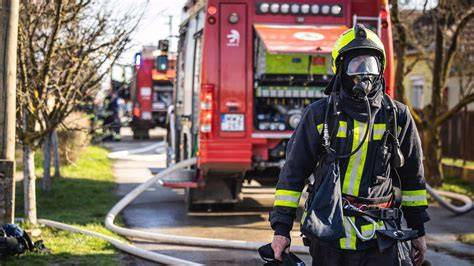
A tűzeset legfontosabb szókincse
- emergency - vészhelyzet
- to be on fire - valami ég
- roommate - szobatárs
- upstairs - felső szint, emelet
- downstairs - alsó szint
- to breathe - lélegezni
- flame - láng
- smoke - füst
- doorjamb - ajtófélfa
- to block - blokkolni, elzárni
Orvosi vészhelyzetek szókincse
A medical emergency során röviden és közvetlenül kell megfogalmazni a tüneteket, a fájdalom helyét és az előzményeket. A következő kifejezések különösen hasznosak lehetnek:
- a pain that is located in the head - fejben jelentkező fájdalom
- a drug that is used to treat or prevent disease - betegség kezelésére vagy megelőzésére használt gyógyszer
- I think I ate something bad. - Azt hiszem, rosszat ettem.
- the state of having an abnormally low level of water in the body - a szervezetben lévő víz rendellenesen alacsony szintje
- Is there a pharmacy nearby? - Van a közelben gyógyszertár?
- Your insurance card, please. - Kérem a biztosítási kártyáját.
Egészségügyi szavak
| Angol szó vagy kifejezés | Magyar jelentés |
|---|---|
| pain | fájdalom |
| head | fej |
| drug | gyógyszer |
| disease | betegség |
| pharmacy | gyógyszertár |
| insurance card | biztosítási kártya |
| distress | veszély vagy kétségbeesett szükséghelyzet |
Útbaigazítás vészhelyzetben
I can't find the way back to my hotel. - Nem találom vissza az utat a szállodámhoz.
Vészhelyzetben a helyszín megadásához hasznos lehet az utcák, sarkok, terek, közlekedési lámpák és kijáratok angol neve. Az irányok pontos megadása segíthet abban, hogy a rendőrség, a mentők vagy a tűzoltók gyorsabban megtalálják a hívót.
| Angol szó | Magyar jelentés |
|---|---|
| to travel or move from one location to another | menni, mozogni |
| straight | egyenesen, közvetlenül |
| to take | venni, kiválasztani |
| second | második, másodlagos |
| turning | kanyar |
| right | jobb |
| traffic lights | közlekedési lámpák, forgalmi jelzőlámpák |
| to turn | forog, pörög |
| square | tér, piac tér |
| third | harmadik |
| exit | kijárat |
| direction | irány, oldal |
| left | bal |
Útbaigazításhoz kapcsolódó példamondatok
Ex: They have been to Australia twice and loved the experience - Kétszer mentek Ausztráliába és imádták a tapasztalatot.
Ex: She stared straight ahead , not acknowledging the crowd - Egyenesen előre bámult, nem ismerve el a tömeget.
Ex: She took the job with the better work-life balance. - Ő vette fel a munkát a jobb munka-élet egyensúllyal.
Ex: The second chapter of the book explains the theory - A könyv második fejezete magyarázza az elméletet.
Ex: The map indicated a sharp turning where we needed to switch from the main road to a dirt trail - A térkép egy éles kanyart jelölt, ahol a főútról egy földútra kellett áttérnünk.
Ex: Make sure to check your right before changing lanes on the highway - Győződjön meg arról, hogy ellenőrzi a jobb oldalát, mielőtt sávot vált az autópályán.
Ex: Pedestrians waited for the green signal from the traffic lights to cross the street safely - A gyalogosok a közlekedési lámpák zöld jelére vártak, hogy biztonságosan kelhessenek át az úton.
Ex: Earth 's rotation causes the planet to go around, creating day and night. - A Föld forgása miatt a bolygó forog, ezzel létrehozva a nappalt és az éjszakát.
Ex: They met in the square to watch the street performers - A téren találkoztak, hogy megnézzék az utcai előadókat.
Ex: Let 's meet at the third coffee shop on this street - Találkozzunk az utca harmadik kávézójában.
Ex: The movie theater had multiple exits to ensure that everyone could leave safely after the show - A moziban több kijárat is volt, hogy mindenki biztonságosan távozhasson a vetítés után.
Ex: The compass indicated the correct direction to help the hikers find their way through the forest - Az iránytű a helyes irányt mutatta, hogy segítse a túrázókat az erdőben való eligazodásban.
Ex: The Earth turns on its axis , causing day and night. - A Föld a tengelye körül forog, ami nappalt és éjszakát okoz.
Ex: The photograph captured the couple , with arms entwined , standing on the left side of the frame . - A fénykép megörökítette a párt, karjuk egymásba fonva, a keret bal oldalán állva.
Szavak a segélyhívás helyzetének leírásához
| Angol szó | Magyar jelentés |
|---|---|
| emergency | egy gyors intézkedést igénylő, váratlan és veszélyes helyzet |
| monitor | figyelni, megfigyelni, meghallgatni vagy ellenőrizni egy meghatározott célból egy időszakon keresztül |
| tense | félelemmel vagy aggodalommal teli |
| distress | veszély vagy kétségbeesett szükséghelyzet |
| significant | elég nagy ahhoz, hogy észrevehető vagy hatással legyen valamire; nagyon fontos |
A segélyhívásban a rövid, egyszerű mondatok a leghasznosabbak, például: „I can’t breathe.”, „I can see flames.”, „There is smoke everywhere.” vagy „I can’t find the way back to my hotel.”